“The Biggest, Busiest & Best Suburb in New England”

The second edition of my book about George F. Willett and Norwood, Mass., is now available: https://rockstreetpress.square.site

What happens when one man dares to reinvent an entire town?

Beginning in 1908, millionaire industrialist George F. Willett proposed to transform Norwood, Massachusetts, into “the biggest, busiest, and best suburban municipality in New England.” Utilizing his personal fortune and driven by reformist zeal, his bold vision promised to change the small town forever. Discover how the grand experiment unfolds, the forces that brought it down, and the surprising ways Willett’s legacy continues to shape Norwood today.

“Cole’s book is an important contribution to the history of Norwood. Featuring both soaring success and tragic failure, it is a cautionary tale, well-told.”
– Patricia J. Fanning, historian and author of Keeping the Past: Norwood at 150

Stages: The Life & Times of a Kansas Actor

New memoir by actor Tom Frye now available: https://rockstreetpress.square.site/

Tom Frye is a beloved actor, director, and educator who has been making people laugh—both on and off stage—for more than half a century. In Stages, he shares his madcap adventures of growing up in a time before color television, building a career as a working actor, and falling in love with life. From his hometown of Wichita, Kansas, to the lights of Broadway and beyond, Frye’s stories are delightful, poignant, and laugh-out-loud funny.

Not quite a celebrity memoir, Stages includes some name-dropping of the rich and famous, but also intimate recollections about close friends and family. Those who know Frye will likely recognize the cast of characters who populate his tales. Those that don’t will want to invite him to the next neighborhood trivia night. And he’ll probably come.

About the Author

Tom Frye is a published playwright with Concord Theatricals and a multiple award-winning actor/director/producer. He earned a bachelor of arts and a master of arts in theatre from Wichita State University and the University of Kansas.

Frye taught theatre at Wichita Southeast High School, Kapaun Mt. Carmel High School, the Independent High School, and Wichita State University. He was a special education teacher at Starkey School, Levy Special Education Center, and Andrew H. Fabrique Elementary School. He also taught ESL at Wichita East High School.

Frye’s theatrical career encompasses more than 400 productions performed in thirty-five states. A highlight was his performance of the one-man play Tru under the direction of its author, the Oscar-nominated playwright Jay Presson Allen, and produced by her three-time Tony Award-winning husband, Lewis Allen.

RSP Author Recognized by State History Organization

Rock Street Press author Patricia J. Fanning was recently recognized by the Mass History Alliance with a STAR Award for her work preserving and sharing local history. Congrats Patti!!!

FOR IMMEDIATE RELEASE
August 18, 2025

Media Contacts:
Massachusetts History Alliance, commons@masshistoryalliance.org

NORWOOD RESIDENT RECOGNIZED BY STATEWIDE HISTORY ORGANIZATION

Patricia J. Fanning, PhD, a lifelong Norwood resident, was recognized by the Mass History Alliance (MHA) in June with the STAR Award for her continued service to preserving and sharing the history of Norwood with the public. Fanning was recognized alongside several other “local history heroes,” as the award describes, from across the Commonwealth. The Mass History Alliance recognized these award recipients at their annual Mass History Conference on June 2, 2025, in Amherst. 

The MHA STAR Awards are modeled on the former Baystate Historical League’s Local History Hero award and began in 2021.With this award, the MHA honors members of the history field who have demonstrated long term commitment, outstanding work with concrete results, exemplary innovation, local leadership for change, or contributions to equity and justice. MHA Star Awards are granted to Massachusetts people who have made outstanding contributions to the research and interpretation of the history of their communities.

Fanning, professor emerita of sociology at Bridgewater State University, is a lifelong resident of Norwood and the primary reason that the town’s history has been so well documented and preserved. She has written several books and numerous articles about Norwood, led two local history organizations, facilitated innumerable public history programs, and is the person anyone turns to if they have a question about Norwood’s past. 

Fanning’s books include Influenza and Inequality: One Town’s Tragic Response to the Great Epidemic of 1918 (UMass Press, 2010) and Through an Uncommon Lens: The Life and Photography of F. Holland Day” (UMass Press, 2008). Fanning has also written academic and popular articles about New England immigration, migration and ethnic history, often using Norwood as a case study. Her two most recent books, Wish You Were Here: Vintage Postcards of Norwood, Ma. (2024) and “A Most Infamous Young Swindler” The Short Tragic Life of Thomas Langrel Harris (2025), were published by Rock Street Press.  

In addition to her academic work, Fanning’s contributions to Norwood’s local history have been tireless. She has been a member of the volunteer-run Norwood Historical Society for 51 years, serving as president for eight years. She has worked to help preserve the F. Holland Day Historic House, home of the Norwood Historical Society, and tell the stories of Norwood’s residents—both famous and obscure. Her efforts included accessioning archival material, conducting research, writing tours, curating exhibits, organizing public programs and serving as archivist and resident expert on F. Holland Day.

Beginning in 2017, Fanning launched an effort to preserve Norwood’s oldest cemetery. She founded and now leads Old Parish Preservation Volunteers, a volunteer non-profit group dedicated to preserving the 283-year-old colonial American burying ground in the heart of Norwood. She also writes a weekly blog sharing the stories of the people buried there and organizes public events at the cemetery.

Massachusetts History Alliance
The mission of the Massachusetts History Alliance and its annual conference is to support and advocate for all public history organizations and their work in Massachusetts by maximizing connections and cross-fertilization, and supporting skills development in the field of public history in Massachusetts.

###

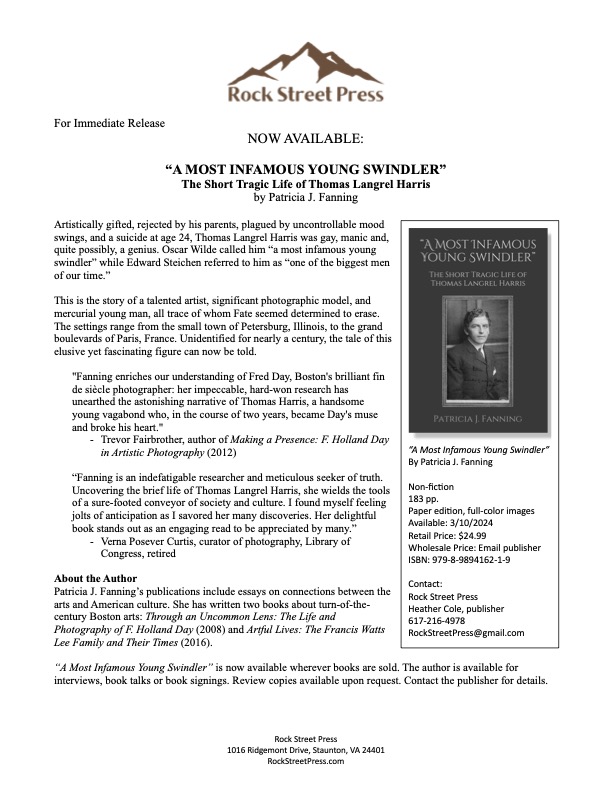
“A Most Infamous Young Swindler” The Short Tragic Life of Thomas Langrel Harris

New book by Patricia J. Fanning now available: https://rockstreetpress.square.site/

About the Book

Artistically gifted, rejected by his parents, plagued by uncontrollable mood swings, and a suicide at age 24, Thomas Langrel Harris was gay, manic and, quite possibly, a genius. Oscar Wilde called him “a most infamous young swindler” while Edward Steichen referred to him as “one of the biggest men of our time.”

This is the story of a talented artist, significant photographic model, and mercurial young man, all trace of whom Fate seemed determined to erase. The settings range from the small town of Petersburg, Illinois, to the grand boulevards of Paris, France. Unidentified for nearly a century, the tale of this elusive yet fascinating figure can now be told.

Advance Reviews

“Fanning enriches our understanding of Fred Day, Boston’s brilliant fin de siècle photographer: her impeccable, hard-won research has unearthed the astonishing narrative of Thomas Harris, a handsome young vagabond who, in the course of two years, became Day’s muse and broke his heart.” — Trevor Fairbrother, author of Making a Presence: F. Holland Day in Artistic Photography (2012)

“Fanning is an indefatigable researcher and meticulous seeker of truth. Uncovering the brief life of Thomas Langrel Harris, she wields the tools of a sure-footed conveyor of society and culture. I found myself feeling jolts of anticipation as I savored her many discoveries. Her delightful book stands out as an engaging read to be appreciated by many.” — Verna Posever Curtis, curator of photography, Library of Congress, retired

About the Author

Patricia J. Fanning’s publications include essays on connections between the arts and American culture. She has written two books about turn-of-the-century Boston arts: Through an Uncommon Lens: The Life and Photography of F. Holland Day (2008) and Artful Lives: The Francis Watts Lee Family and Their Times (2016).

Rock Street Press Author Wins National Recognition

I am super-excited to share that historian and author Patricia J. Fanning, author of Wish You Were Here: Vintage Postcards of Norwood, Ma. published by Rock Street Press in February, is recipient of the AASLH Lifetime Achievement Award for 2024. CONGRATS!!

FOR IMMEDIATE RELEASE

June 24, 2024

Contact: Aja Bain, AASLH Senior Manager
of Professional Development and Publications
615-320-3203
abain@aaslh.org

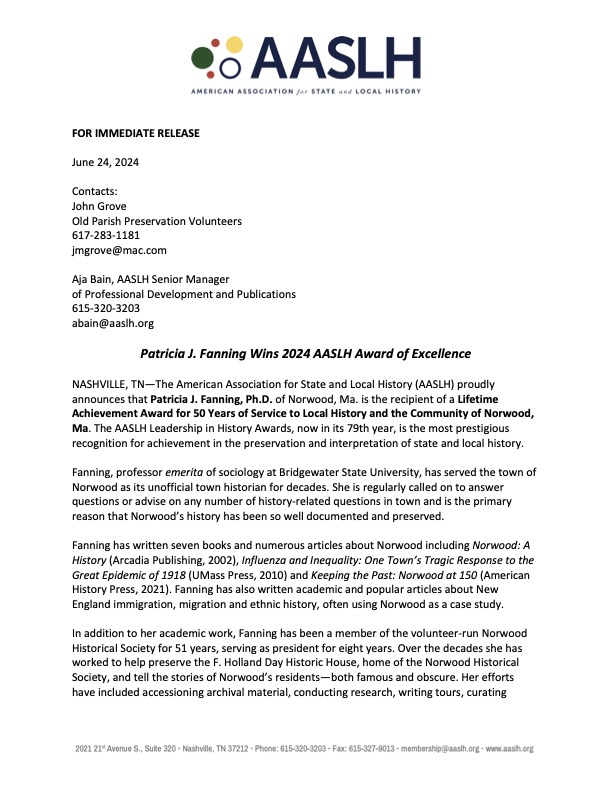
Patricia J. Fanning Wins 2024 AASLH Award of Excellence

NASHVILLE, TN—The American Association for State and Local History (AASLH) proudly announces that Patricia J. Fanning, Ph.D. of Norwood, Ma. is the recipient of a Lifetime Achievement Award for 50 Years of Service to Local History and the Community of Norwood, Ma. The AASLH Leadership in History Awards, now in its 79th year, is the most prestigious recognition for achievement in the preservation and interpretation of state and local history.

Fanning, professor emerita of sociology at Bridgewater State University, has served the town of Norwood as its unofficial town historian for decades. She is regularly called on to answer questions or advise on any number of history-related questions in town and is the primary reason that Norwood’s history has been so well documented and preserved.

Fanning has written seven books and numerous articles about Norwood including Norwood: A History (Arcadia Publishing, 2002), Influenza and Inequality: One Town’s Tragic Response to the Great Epidemic of 1918 (UMass Press, 2010) and Keeping the Past: Norwood at 150 (American History Press, 2021).Fanning has also written academic and popular articles about New England immigration, migration and ethnic history, often using Norwood as a case study.

In addition to her academic work, Fanning has been a member of the volunteer-run Norwood Historical Society for 51 years, serving as president for eight years. Over the decades she has worked to help preserve the F. Holland Day Historic House, home of the Norwood Historical Society, and tell the stories of Norwood’s residents—both famous and obscure. Her efforts have included accessioning archival material, conducting research, writing tours, curating exhibits, organizing public programs and serving as archivist and resident expert on photographer F. Holland Day.

Beginning in 2017, Fanning launched an effort to preserve the town’s oldest cemetery. She founded and now leads Old Parish Preservation Volunteers, a volunteer non-profit group dedicated to preserving the 283-year-old colonial American burying ground in the heart of Norwood. She also writes a weekly blog sharing the stories of the people buried there and organizes public events at the cemetery.

This year, AASLH confers 47 national awards honoring people, projects, exhibits, and publications. The winners represent the best in the field and provide leadership for the future of state and local history.

The AASLH awards program was initiated in 1945 to establish and encourage standards of excellence in the collection, preservation, and interpretation of state and local history throughout the United States. The AASLH Leadership in History Awards not only honor significant achievement in the field of state and local history, but also bring public recognition of the opportunities for small and large organizations, institutions, and programs to make contributions in this arena. For more information about the Leadership in History Awards, contact AASLH at 615-320-3203 or go to www.aaslh.org.

Old Parish Preservation Volunteers (OPPV) is a volunteer non-profit group founded in 2018 whose mission is to restore, enhance and raise public awareness of the Old Parish Cemetery in Norwood, Ma.

The American Association for State and Local History is a not-for-profit professional organization of individuals and institutions working to preserve and promote history. From its headquarters in Nashville, Tennessee, AASLH provides leadership, service, and support for its members who preserve and interpret state and local history in order to make the past more meaningful to all people. AASLH publishes books, technical publications, a quarterly magazine and maintains numerous affinity communities and committees serving a broad range of constituents across the historical community. The association also sponsors an annual meeting, regional and national training in-person workshops and online training.

###

Wish You Were Here: Vintage Postcards of Norwood, MA

New Local History Book Now Available!

Author Patricia J. Fanning’s newest book, Wish You Were Here: Vintage Postcards of Norwood, Massachusetts, is available February 12 from Rock Street Press. This full-color publication features more than 150 postcards from the private collection of a Norwood family, expertly annotated by Norwood’s town historian. It is an engaging visual tour through Norwood’s past and a great gift for fans of local history, vintage postcards or early 20th century photography.

About the Book

The postcards in this volume, all from the Robert N. and Susan Donahue Collection, tell the story of this community from its founding to the late twentieth century. Businesses, houses of worship, educational, health care and recreational facilities, public buildings, landmarks and homes are all represented. For many, these views will spark nostalgia; for others, they will be totally unfamiliar. Either way, this is vintage Norwood.

About the Author

Patricia J. Fanning is a life-long resident of Norwood, Massachusetts and professor emerita of sociology at Bridgewater State University. A former president of the Norwood Historical Society and current president of the Old Parish Preservation Volunteers, she has written several books related to the town of Norwood including Norwood: A History (2002), Images of America: South Norwood (2004), Influenza and Inequality: One Town’s Tragic Response to the Great Epidemic of 1918 (2010), Keeping the Past: Norwood at 150 (2021), and Old Parish Cemetery of Norwood, Massachusetts (2023).

About Rock Street Press

Rock Street Press is a small book publisher specializing in local history, culture and memoir. We are based in the Shenandoah Valley of Virginia.

Screenshot

2026 Upcoming Events

All events are free and open to the public, unless otherwise noted.

Saturday, April 25, 2026 from 10 a.m.-3 p.m.: I’ll be signing books at the Rocktown Author Festival at the Massanutten Regional Library’s central branch in downtown Harrisonburg.

Tuesday, April 28, 2026: I’ll be presenting “On the Road with the Virginia Presidents” for OLLI at George Mason University. Register here: https://olli.gmu.edu/current-catalog/

Now booking talks for spring and summer 2026 — contact me for details…

The Civil War

“Road Schooling American History: The Civil War” by Heather S. Cole

We moved to the Shenandoah Valley from the Boston area in 2014. In our first six months, I heard more discussion about “the war between the states” than I had in nearly 20 years in New England. I came to understand that some of this was cultural, but a lot of the reason for a continued interest in the war was purely geographical. Virginia was both literally and figuratively at the center of the Civil War and, even more than 150 years later, the effects are still being felt here in ways that they just aren’t in the north. As I tried to wrap my head around the debate over Confederate flags and statues of dead generals, I realized that there was a lot that I still didn’t understand about the Civil War.

Fortunately, I had a 7-year-old boy who was obsessed with guns and soldiers and warfare. Civil War reenactments were the perfect way to combine his interests and mine. Thus, the Civil War ended up being the first subject that we homeschooled, before we officially pulled him from public school. Our spines for this class were: a map of Virginia, a list of the major battles of the Civil War and a print-out of upcoming reenactments. Here are some of our favorite sites…

Gettysburg/Antietam/Harpers Ferry

We started our Civil War exploration just north of the Virginia border with a whirlwind weekend-long visit to Gettysburg, Antietam and Harpers Ferry. It was, in retrospect, nowhere near enough time. At Gettysburg National Military Park (Gettysburg, PA) we opted for the tour package that included the museum, film and cyclorama exhibit. That, along with a quick drive-through of the highlights of the battlefield, was all we were able to accomplish in one day. There were a myriad of ranger programs and other exhibits that we could have seen; but we just ran out of time.

The Antietam National Battlefield (Sharpsburg, MD) is a smaller site, so here the kids were able to walk around and get a better idea of the scope of the battle. We were there during one of their living history weekends, so the kids were excited to pet the reenactors’ horses and watch firearm demonstrations. The kids also earned their Junior Ranger badges by completing several activities there.

However, the highlight of our weekend was Harpers Ferry (WV). Located at the intersection of the Potomac and Shenandoah Rivers, the picturesque town comprises both the Harpers Ferry National Historical Park and Harpers Ferry Historic District. The National Park includes several Civil War-era museums, including the site of abolitionist John Brown’s failed 1859 slave rebellion. The Historic District features beautifully-restored 19th century homes and stores, including my kids’ favorite: an ice cream parlor. The Appalachian Trail also cuts through Harpers Ferry, and there are local outfitters that offer biking, hiking and kayaking supplies.

We made a second trip to Gettysburg later that summer to attend the Gettysburg Anniversary National Civil War Battle Reenactment. Run by a group unaffiliated with the National Park, this reenactment is claimed to be the largest in the country. It certainly was the largest and most well-organized reenactment that we’ve attended. In addition to battle reenactments, there were both Union and Confederate encampments, period shops, musical performances and kids activities. (Just be aware that it is a 100% outdoor event and tickets are non-refundable.)

Shenandoah Valley

Although often overlooked, the Shenandoah Valley has a wealth of Civil War sites: Cedar Creek, New Market, Rockingham County, Waynesboro, Lexington. We’ve enjoyed visiting these sites because they tend to be less crowded, giving kids more of an opportunity to interact with museum staff and reenactors.

One of my favorite Civil War sites in the Shenandoah Valley is the Confederate Breastworks Interpretive Trail in the George Washington National Forest, west of Staunton. The isolated half-mile trail along the top of Shenandoah Mountain has interpretive signs with excerpts of letters from a Confederate soldier to his wife, giving hikers a sense as to what it might have been like to be a soldier marching, sleeping and fighting in the mountain wilderness.

My kids preferred our day trip to Lexington where we visited the Virginia Military Institute Museum, home to an extensive antique firearm collection and the taxidermied hide of Stonewall Jackson’s horse. 

Educational Programs

Joining a reenacting regiment is undoubtedly the best way to really experience life of a Civil War soldier. If your family is the type that enjoys sleeping under the stars, eating over a campfire and marching in wool clothing in 90 degree weather—then you can find information on regiments at any reenactment or through the sidebar links. I, however, wanted to sit in air-conditioned comfort while my children enjoyed those adventures.

So I was happy to discover the day camps at the Virginia Museum of the Civil War in New Market. The museum and surrounding battlefield are owned by the Virginia Military Institute, whose young cadets fought in the 1864 battle. Their week-long Civil War Day Camp is focuses on giving students the experience of a Civil War soldier—complete with marching drills and sampling of hardtack. My boys attended the camp for three summers and their favorite experiences included learning period songs and playing war with wooden muskets amongst the historic houses on the farm. I was especially pleased about the reasonable cost of the camp.

Another organization that offers a variety of educational programs about the Civil War is the American Battlefield Trust. My son and I spent a weekend in Washington, D.C. participating in a day-long reenactment that was part of their “Generations” initiative to interest young people in history. The free program also included a period lunch.

Since many of the Civil War sites are owned by the National Park Service, I also wanted to remind readers about their Every Kid in a Park program. Any fourth grader (or homeschool equivalent) can get a free one-year national park pass. Visit everykidinapark.gov for details.

***

Historic Sites:

Antietam National Battlefield, Sharpsburg, MD: nps.gov/anti

Confederate Breastworks Interpretive Site, West Augusta: fs.usda.gov/recarea/gwj/recarea/?recid=73663

Gettysburg Anniversary National Civil War Battle Reenactment: gettysburgreenactment.com

Gettysburg National Military Park, Gettysburg, PA: nps.gov/gett

Harpers Ferry National Historical Park, Harpers Ferry, WV: nps.gov/hafe

Historic Harpers Ferry, Harpers Ferry, WV: historicharpersferry.com

Virginia Military Institute Museum, Lexington: vmi.edu/museums-and-archives/vmi-museum

Virginia Museum of the Civil War, New Market: vmi.edu/newmarket

Favorite Books:

Alphin, Elaine Marie. Ghost Cadet. Scholastic Paperbacks (1992).

Beitler, Margaret Bigham. Jimmy at Gettysburg. Horner Enterprises (1992).

Fletcher, Susan. Dadblamed Union Army Cow. Candlewick (2007).

Greenwood, Barbara. The Last Safe House: A Story of the Underground Railroad. Kids Can Press (1998).

Raven, Margot Theis. Night Boat to Freedom. Square Fish (2008).

Other Resources:

American Battlefield Trust: battlefields.org

Civil War Reenactment HQ: reenactmenthq.com

Civil War Traveler (reenactment schedule): civilwartraveler.com 

National Park Service Every Kid in a Park program: everykidinapark.gov

Shenandoah Valley Battlefields: shenandoahatwar.org

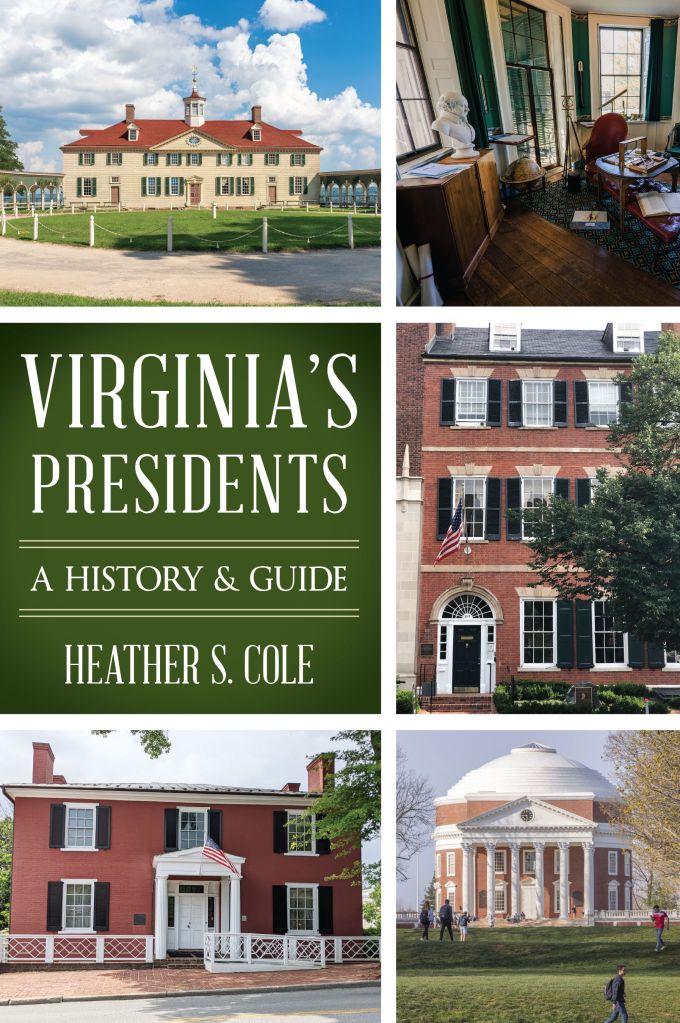
Virginia’s Presidents: A History and Guide

What do George Washington, Thomas Jefferson, James Madison, James Monroe, William Henry Harrison, John Tyler and Zachary Taylor have in common? They were all born in Virginia–-making the Old Dominion the birthplace of more United States Presidents than any other state in the Union.

Among these eight Virginians were those who established a new nation, drafted our founding documents, fought in numerous battles, led the country through wars and created an international peacekeeping organization. But these men also used their power to force Native Americans off their land, perpetuate the institution of slavery in new states and territories, and prevent women from obtaining the right to vote.

Across the Commonwealth of Virginia and beyond are more than two dozen presidential homes, museums and historic sites that tell the stories of the eight Virginia-born Presidents. While some were originally founded to enshrine the memory of our Founding Fathers, most presidential homes and museums no longer uncritically celebrate their lives. Instead, many of these sites have expanded their interpretation to include a more complicated and nuanced story about our Presidents and include the stories of the other men, women and children–-enslaved and free–-who supported them in their political, military and civilian careers.

My newest book tells the stories of the Virginia Presidents and the historic sites that interpret their lives. It includes profiles of each of the eight Presidents and descriptions of the museums, historic sites and presidential homes in Virginia and surrounding states that tell their stories and, by extension, the story of our nation.

Caving in Virginia

caving5“Roads Scholars: Caving in Virginia” by Heather S. Cole
VA Homeschoolers Voice, September-October 2019

I am in the dark, dozens of feet underground, covered by mud and perched on a ledge alongside a small group of family and friends. To get here, I lowered myself by rope into a ditch, then crawled on my belly through the cave entrance. We’ve been scrambling over and under rock formations for the past hour. All I can see is the circle that my headlamp illuminates as I turn my head from side-to-side. I have absolutely no idea where we are or how to get out. And our guide has just handed the only map of the cave to my 9-year-old son. Needless to say, I’m a little nervous.

The Shenandoah Valley and West Virginia are dotted with hundreds of caves, formed over centuries by rainwater seeping through the ground and dissolving pockets in the limestone that comprises much of the landscape. Most of the caves are what spelunkers call “wild”—no lights, no handrails, no paved trails—and are located on private land. However, with a licensed guide and the proper equipment, many of these caves can be explored by the novice hiker.

We were first introduced to wild caving through trips offers by our local Recreation Department. A few months later, we organized a group and hired certified guide Lester Zook of Wild Guyde Adventures (wildguyde.com) to take us on a half-day adventure. The spelunkers in our group ranged in age from eight to 65 years old and were all comfortable hiking above ground. We wore helmets, head-lamps and hiking shoes, along with an outer layer of clothing that could (and did) get muddy. Lester spent a lot of time talking about cave safety, taught us how to read a cave map and even the youngest in our group got a chance to navigate. While the formations in the wild cave we explored were not as striking as those in commercial caves, it was more than made up for by the feeling of exploring undiscovered territory.

Most of the trek was hiking upright—on par with many of the moderate trails we’d hiked in Virginia and Arizona. We found that we moved pretty slowly and used our hands a lot more to help us through the cave, as much because the rocks were wet as because it was a difficult trek. We got used to the darkness pretty quickly, and I found the 55 degree temperature perfect. There were a few places where we had to squeeze through smaller spaces or crawl on our knees, so wild caving is certainly not for folks prone to claustrophobia or with health issues.

You should NEVER enter a cave without an experienced guide and the correct equipment. Several municipal recreation departments in the Shenandoah Valley offer guided caving trips for $20-40 per person. There are also several certified guides who lead wild caving treks for small groups, starting at a similar price per person. Search online for “Virginia cave adventures” or ask for a referral at your local hiking outfitter.

When we finally emerged into the sunlight a few hours later, we were exhausted and filthy, but proud of what we’d accomplished and most of us excited to go caving again. (My mom said she’d stick to hiking the desert canyons of Arizona.) We stripped off our outermost layer and threw them into a bag to await our next wild underground adventure.

***

SIDEBAR

If crawling on your belly through the mud in the dark is not your idea of fun, then that’s a shame. But you can still see some of Virginia’s amazing underground rock formations by touring a commercial cave. The caverns listed below are fully lit and you will be walking along a paved or gravel pathway, usually with hand railings and stairs. Commercial cave tours generally last one to one-and-a-half hours and rates are $5-$15 for kids, $15-25 for adults. Even with the commercial caverns, the paths tend to be damp and temperatures average 55 degrees year round, so make sure to wear sneakers and bring a sweatshirt. Most of Virginia’s commercial caves are located in the Shenandoah Valley and are listed roughly north to south.

Skyline Caverns, Front Royal: skylinecaverns.com

Skyline is the northernmost commercial cavern in Virginia, located just outside of Front Royal. This cavern includes three underground streams and a waterfall and is one of the only places where you can see a rare needle-like crystal formation called an anthodite. While at Skyline Caverns, visitors can also ride a miniature train and go through a mirror maze.

Shenandoah Caverns, Quicksburg: shenandoahcaverns.com

Shenandoah Caverns is located on Interstate 81 between New Market and Mt. Jackson. It is the only Virginia cavern with an elevator, although you’ll still need to do lots of walking once you get inside. Some of the cool formations at Shenandoah Caverns include Rainbow Lake and formations that look like strips of bacon. Adjacent to the cave are two museums that feature old parade floats and antique department store window displays.

Luray Caverns, Luray: luraycaverns.com 

If you’re driving along Interstate 81 through the Shenandoah Valley, you can’t miss the numerous billboards advertising Luray Caverns, the largest cavern in the eastern United States. Tours of Luray Caverns are mostly stroller-friendly and one of the neat features inside is a stalacpipe organ: a musical instrument made of stalactites. Visitors can make a day of visiting Luray, with an adjacent garden maze, rope adventure park and car museum. Luray Caverns offers a homeschool week in March, and the education page of their website has some geology experiments for kids.

Endless Caverns, New Market: endlesscaverns.com

You’ll know you’re close to this cave when you can see the Hollywood-style sign in the mountains to the east. This is one of two caverns in Virginia to have the unusual shield formations inside. There is a campground on site, in case you want to make a weekend of it and explore some of the historic sites in New Market. Please note, however, that Endless Caverns is closed from mid-November to April 1 and strollers are not permitted on the tours.

Grand Caverns, Grottos: grandcaverns.com

Grand Caverns is our family’s favorite of the Shenandoah Valley caves, both because of the interesting formations and because it’s the closest commercial cave to our Staunton home. There is a small museum on-site and the adjacent municipal park has a playground and outdoor swimming pool. One weekend in early December, Grand Caverns hosts Christmas caroling in the caverns, a popular event. For folks who want something more adventurous than a commercial tour, once a month Grand offers tours of an adjacent cave that has been in disuse since the early 1900s. The Fountain Cave Adventure Tour takes visitors ages 12 years and older along a rugged 100-year-old pathway and requires the use of headlamps (and advance reservations).

Natural Bridge Caverns, Natural Bridge: naturalbridgeva.com/caverns.html

Natural Bridges Caverns is next to the state park complex that includes Natural Bridge and the Monacan Living History Exhibit, the three sites combining to make for a nice day trip. The caverns are open from March through November only, and they offer a homeschool day in the fall.

Dixie Caverns, Salem: dixiecaverns.com

Dixie Caverns is located in Salem, about 20 minutes west of Roanoke. Among its attractions is a wedding bell formation, under which you can get married—with advanced notice.The caverns are adjacent to a campground and an antique mall.

Gap Caverns, Ewing: nps.gov/cuga

Gap Caverns is located within the Cumberland Gap National Historical Park, encompassing portions of Virginia, Tennessee and Kentucky. The cave tours are described as moderately strenuous and children under the age of five years are not permitted. At the time of writing, bats in Gap Caverns have been found to have White-nose Syndrome, a fungal infection that is harmless to humans but life-threatening and very contagious to bats. See the NPS website for details on what to wear for a tour. Gap Caverns is open April through September and there are a variety of hiking, camping and Junior Ranger programs in the park. 

Heather Cole wrangles two adventure-loving boys in Staunton, Virginia. She is working on an article about homeschoolers hiking the Appalachian Trail. If you and your kids have thru-hiked, slack-hiked or overnight-hiked on the AT, send her an email.