
 “Roads Scholars: Caving in Virginia” by Heather S. Cole
VA Homeschoolers Voice, September-October 2019
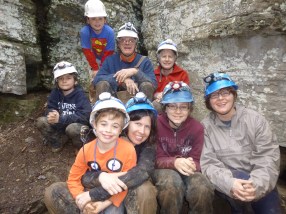
I am in the dark, dozens of feet underground, covered by mud and perched on a ledge alongside a small group of family and friends. To get here, I lowered myself by rope into a ditch, then crawled on my belly through the cave entrance. We’ve been scrambling over and under rock formations for the past hour. All I can see is the circle that my headlamp illuminates as I turn my head from side-to-side. I have absolutely no idea where we are or how to get out. And our guide has just handed the only map of the cave to my 9-year-old son. Needless to say, I’m a little nervous.
The Shenandoah Valley and West Virginia are dotted with hundreds of caves, formed over centuries by rainwater seeping through the ground and dissolving pockets in the limestone that comprises much of the landscape. Most of the caves are what spelunkers call “wild”—no lights, no handrails, no paved trails—and are located on private land. However, with a licensed guide and the proper equipment, many of these caves can be explored by the novice hiker.
We were first introduced to wild caving through trips offers by our local Recreation Department. A few months later, we organized a group and hired certified guide Lester Zook of Wild Guyde Adventures (wildguyde.com) to take us on a half-day adventure. The spelunkers in our group ranged in age from eight to 65 years old and were all comfortable hiking above ground. We wore helmets, head-lamps and hiking shoes, along with an outer layer of clothing that could (and did) get muddy. Lester spent a lot of time talking about cave safety, taught us how to read a cave map and even the youngest in our group got a chance to navigate. While the formations in the wild cave we explored were not as striking as those in commercial caves, it was more than made up for by the feeling of exploring undiscovered territory.
Most of the trek was hiking upright—on par with many of the moderate trails we’d hiked in Virginia and Arizona. We found that we moved pretty slowly and used our hands a lot more to help us through the cave, as much because the rocks were wet as because it was a difficult trek. We got used to the darkness pretty quickly, and I found the 55 degree temperature perfect. There were a few places where we had to squeeze through smaller spaces or crawl on our knees, so wild caving is certainly not for folks prone to claustrophobia or with health issues.
You should NEVER enter a cave without an experienced guide and the correct equipment. Several municipal recreation departments in the Shenandoah Valley offer guided caving trips for $20-40 per person. There are also several certified guides who lead wild caving treks for small groups, starting at a similar price per person. Search online for “Virginia cave adventures” or ask for a referral at your local hiking outfitter.
When we finally emerged into the sunlight a few hours later, we were exhausted and filthy, but proud of what we’d accomplished and most of us excited to go caving again. (My mom said she’d stick to hiking the desert canyons of Arizona.) We stripped off our outermost layer and threw them into a bag to await our next wild underground adventure.
***
SIDEBAR
If crawling on your belly through the mud in the dark is not your idea of fun, then that’s a shame. But you can still see some of Virginia’s amazing underground rock formations by touring a commercial cave. The caverns listed below are fully lit and you will be walking along a paved or gravel pathway, usually with hand railings and stairs. Commercial cave tours generally last one to one-and-a-half hours and rates are $5-$15 for kids, $15-25 for adults. Even with the commercial caverns, the paths tend to be damp and temperatures average 55 degrees year round, so make sure to wear sneakers and bring a sweatshirt. Most of Virginia’s commercial caves are located in the Shenandoah Valley and are listed roughly north to south.
Skyline Caverns, Front Royal: skylinecaverns.com
Skyline is the northernmost commercial cavern in Virginia, located just outside of Front Royal. This cavern includes three underground streams and a waterfall and is one of the only places where you can see a rare needle-like crystal formation called an anthodite. While at Skyline Caverns, visitors can also ride a miniature train and go through a mirror maze.
Shenandoah Caverns, Quicksburg: shenandoahcaverns.com
Shenandoah Caverns is located on Interstate 81 between New Market and Mt. Jackson. It is the only Virginia cavern with an elevator, although you’ll still need to do lots of walking once you get inside. Some of the cool formations at Shenandoah Caverns include Rainbow Lake and formations that look like strips of bacon. Adjacent to the cave are two museums that feature old parade floats and antique department store window displays.
Luray Caverns, Luray: luraycaverns.com
If you’re driving along Interstate 81 through the Shenandoah Valley, you can’t miss the numerous billboards advertising Luray Caverns, the largest cavern in the eastern United States. Tours of Luray Caverns are mostly stroller-friendly and one of the neat features inside is a stalacpipe organ: a musical instrument made of stalactites. Visitors can make a day of visiting Luray, with an adjacent garden maze, rope adventure park and car museum. Luray Caverns offers a homeschool week in March, and the education page of their website has some geology experiments for kids.
Endless Caverns, New Market: endlesscaverns.com
You’ll know you’re close to this cave when you can see the Hollywood-style sign in the mountains to the east. This is one of two caverns in Virginia to have the unusual shield formations inside. There is a campground on site, in case you want to make a weekend of it and explore some of the historic sites in New Market. Please note, however, that Endless Caverns is closed from mid-November to April 1 and strollers are not permitted on the tours.
Grand Caverns, Grottos: grandcaverns.com
Grand Caverns is our family’s favorite of the Shenandoah Valley caves, both because of the interesting formations and because it’s the closest commercial cave to our Staunton home. There is a small museum on-site and the adjacent municipal park has a playground and outdoor swimming pool. One weekend in early December, Grand Caverns hosts Christmas caroling in the caverns, a popular event. For folks who want something more adventurous than a commercial tour, once a month Grand offers tours of an adjacent cave that has been in disuse since the early 1900s. The Fountain Cave Adventure Tour takes visitors ages 12 years and older along a rugged 100-year-old pathway and requires the use of headlamps (and advance reservations).
Natural Bridge Caverns, Natural Bridge: naturalbridgeva.com/caverns.html
Natural Bridges Caverns is next to the state park complex that includes Natural Bridge and the Monacan Living History Exhibit, the three sites combining to make for a nice day trip. The caverns are open from March through November only, and they offer a homeschool day in the fall.
Dixie Caverns, Salem: dixiecaverns.com
Dixie Caverns is located in Salem, about 20 minutes west of Roanoke. Among its attractions is a wedding bell formation, under which you can get married—with advanced notice.The caverns are adjacent to a campground and an antique mall.
Gap Caverns, Ewing: nps.gov/cuga
Gap Caverns is located within the Cumberland Gap National Historical Park, encompassing portions of Virginia, Tennessee and Kentucky. The cave tours are described as moderately strenuous and children under the age of five years are not permitted. At the time of writing, bats in Gap Caverns have been found to have White-nose Syndrome, a fungal infection that is harmless to humans but life-threatening and very contagious to bats. See the NPS website for details on what to wear for a tour. Gap Caverns is open April through September and there are a variety of hiking, camping and Junior Ranger programs in the park.
Heather Cole wrangles two adventure-loving boys in Staunton, Virginia. She is working on an article about homeschoolers hiking the Appalachian Trail. If you and your kids have thru-hiked, slack-hiked or overnight-hiked on the AT, send her an email.
 “Road Tripping American History: Westward Expansion” by Heather S. Cole
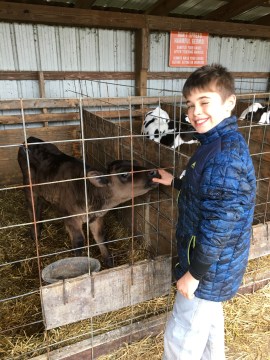 On a trip through Vermont many (pre-kid) years ago, my husband and I stopped at so many dairies, farm stores and breweries that we joked that we could live for a week on free samples. While I don’t advocate taking advantage of small, family-run businesses, I do advocate eating local as much as possible. And it’s so much more fun if you can see how your food is made, or even make it yourself. In our homeschool, we count food field trips as science, home economics, math… even history. To that end, here are some family-friendly destinations for your own food tour across Virginia.
 The cold, dark days of winter are the perfect time to plan an escape to somewhere warmer. For your 2019 adventures, let me humbly suggest someplace hot. Really hot. Like the middle of a supervolcano.
 Pop quiz: What state was birthplace to the greatest number of U.S. presidents? If you said Virginia, you’re right. Bonus points if you can name all eight presidents and their Old Dominion homes.
 I’m a public historian by training. While I was in graduate school, I helped K-12 social studies and history teachers figure out how to use primary sources in their classrooms. I’ve worked in archives and museums and used primary sources in my own research. Yet I’ll admit that my first instinct when homeschooling history with my own kids was to turn to the experts—historians, authors, documentarians—rather than letting my children loose on the “real stuff” of history. We visited several museums and historical sites—which were immensely valuable in bringing the past to life—but I taught an entire semester on the colonial period of American history without showing my kids a single land grant, treaty or narrative written by the people who lived through the events we discussed. They are too young to understand the language, I told myself. They won’t appreciate the historical context. We have so much material to cover, we just don’t have the time.
 It is a fall ritual that many of us who attended public school will remember: rows of little boys and girls in black construction paper hats and brightly-colored feathered headbands file onto the stage of the school gymnasium. A few students carry baskets of food: turkey, applies, cranberries, maybe a pumpkin pie. They place the offerings around a crepe paper fire, join hands and sing a song or two about the Pilgrims, the Indians and the First Thanksgiving in the new world. Parents clap proudly, and everyone adjourns to the cafeteria for apple cider and popcorn.
 Heather S. Cole